Updated 7 November 2026 · Shakeel runs our in-house print room, where every poster is printed and cut to size.
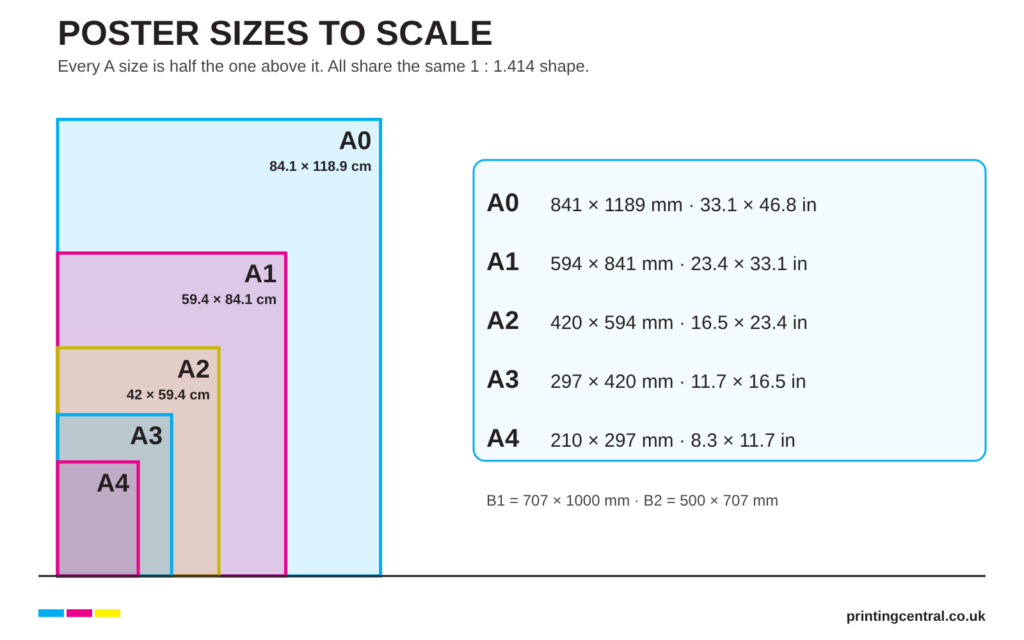
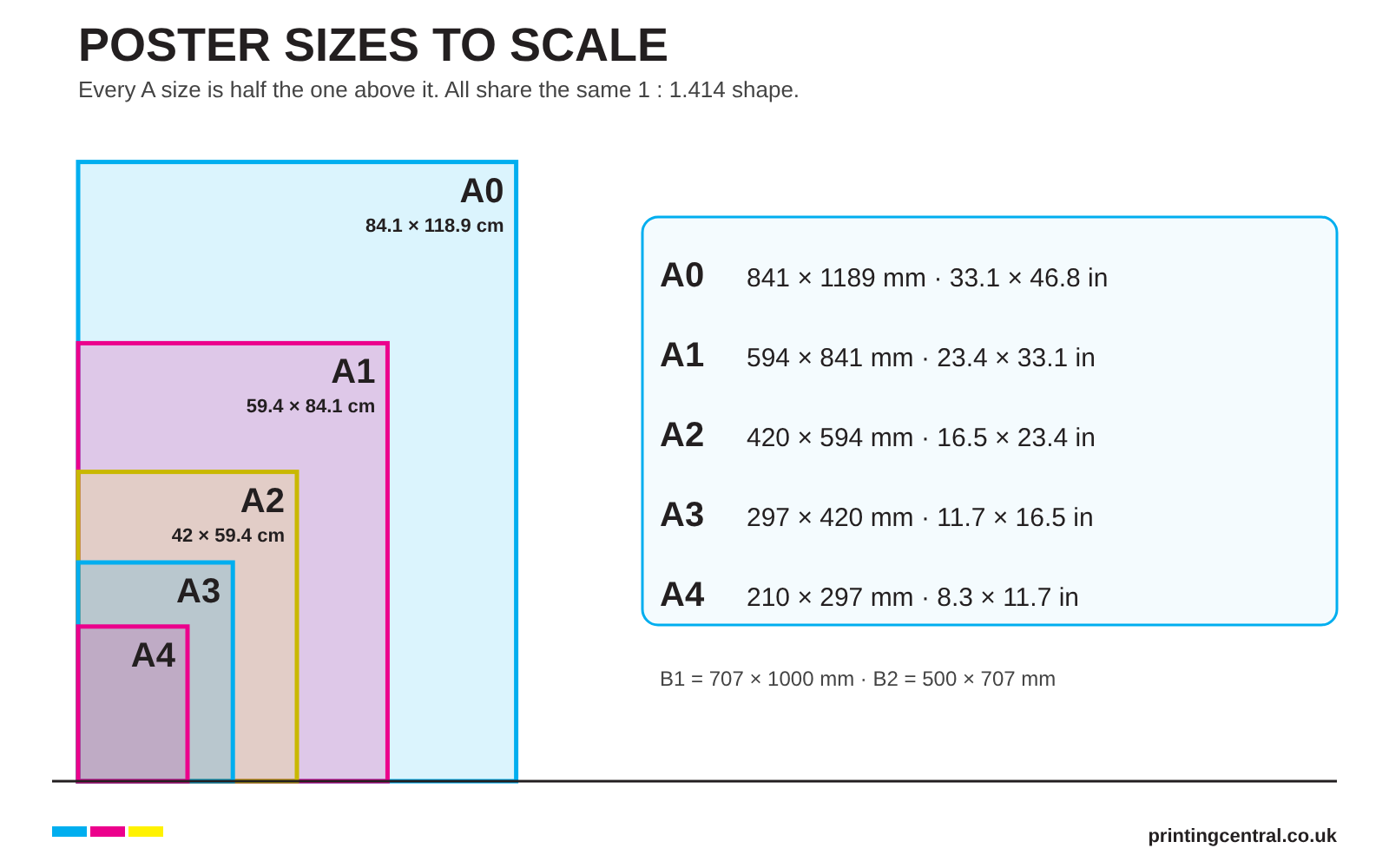
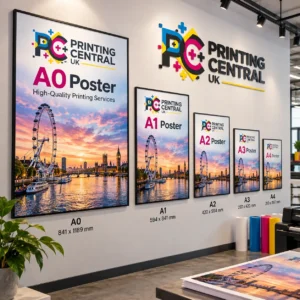
The standard UK poster sizes are A4 (21 × 29.7 cm), A3 (29.7 × 42 cm), A2 (42 × 59.4 cm), A1 (59.4 × 84.1 cm) and A0 (84.1 × 118.9 cm). Each step is approximately twice the area of the one below it, with a nominal aspect ratio of 1:√2; published millimetre dimensions are rounded. Choose by how far away people will be: A4 and A3 for close reading, A2 across a room, A1 or A0 from several metres.
UK poster sizes at a glance
Prices are for one portrait poster on 170gsm silk paper, plus delivery. Read-from distances match our Poster Size Comparer. Tap a size to order.
Exact poster dimensions
| Size | Millimetres | Centimetres | Inches |
|---|---|---|---|
| A4 | 210 × 297 | 21 × 29.7 | 8.3 × 11.7 |
| A3 | 297 × 420 | 29.7 × 42 | 11.7 × 16.5 |
| A2 | 420 × 594 | 42 × 59.4 | 16.5 × 23.4 |
| B2 | 500 × 707 | 50 × 70.7 | 19.7 × 27.8 |
| A1 | 594 × 841 | 59.4 × 84.1 | 23.4 × 33.1 |
| B1 | 707 × 1000 | 70.7 × 100 | 27.8 × 39.4 |
| A0 | 841 × 1189 | 84.1 × 118.9 | 33.1 × 46.8 |
What are the standard poster sizes in the UK?
UK posters use the A series from the international paper standard ISO 216. A0 has an area of one square metre. Every smaller size is made by cutting the one above it in half across its long side, so A1 is half of A0, A2 is half of A1, and so on down to A4.
All A sizes share a 1 : 1.414 shape (the ratio of 1 to the square root of 2). That is why a design made for A3 can be printed at A1 or A0 without cropping or stretching, as long as the artwork has enough resolution.
The B sizes from the same standard sit in between. B2 (50 × 70.7 cm) is between A2 and A1, and B1 (70.7 × 100 cm) is between A1 and A0. They are useful when one A size looks too small and the next one up will not fit the space.
Which poster size should I choose?
Start with distance, then check the wall or window. A poster has to be read from where people actually stand or walk past, not from where you stand while designing it. A menu by a till is read from arm’s length, so A3 or A4 is enough. A shop-window poster is usually read from the pavement, so A1 is often the better choice. A poster across a hall or exhibition aisle needs A0 or B1.
Use the calculator below to check your own headline. Enter the viewing distance and the number of characters in your longest headline line, and it estimates a headline letter height and checks one-line headline width. This is a starting point, not a complete poster layout or a guarantee of readability; allow space for the rest of your content.
Poster size from viewing distance
Tell us how far away people will be and how long your headline is. We work out how tall the letters should be and which standard poster sizes can fit that headline on one line.
How this works: headline height uses a legibility index of 1 inch of letter height per 10 feet of distance (about 1 cm per 1.2 m), from Garvey & Klena's 2020 research on wall-mounted signs. The bare minimum uses the US road-sign standard of 1 inch per 30 feet (about 1 cm per 3.6 m). Width assumes an average bold sans-serif capital is about 0.6 times as wide as it is tall, with a 5% margin each side. Fonts vary, so treat the result as a starting point and check a printed test or the Poster Size Comparer. Prices are the product-page prices for one poster on 6 Nov 2026.
Want to see the sizes against a door and a person? The Poster Size Comparer draws A0, A1, A2, A3, A4, B1 and B2 to scale, overlaid or on a wall.
How big should the text be on a poster?
Sign researchers measure readability with a “legibility index”: how many feet away a letter can be read for each inch of its height. A 2020 study of wall-mounted signs by Garvey and Klena used 1 inch of letter height per 10 feet of distance as a minimum for passing drivers. That works out at roughly 1 cm of letter height for every 1.2 m of viewing distance, and it is the figure our calculator uses for headlines.
US road-sign guidance is less generous, at 30 feet per inch of letter height (about 1 cm per 3.6 m). That figure relates to road signs; it is not a universal minimum for poster readability or accessibility. Font, contrast, lighting, viewing time and the reader all matter. Check the final layout at its intended distance.
| Viewing distance | Headline letters (1 cm per 1.2 m) | Bare minimum (1 cm per 3.6 m) | Smallest size for a 12-character headline |
|---|---|---|---|
| 1 m (3 ft) | 0.8 cm | 0.3 cm | A4 |
| 2 m (7 ft) | 1.7 cm | 0.6 cm | A4 |
| 3 m (10 ft) | 2.5 cm | 0.8 cm | A4 |
| 5 m (16 ft) | 4.2 cm | 1.4 cm | A2 |
| 8 m (26 ft) | 6.7 cm | 2.2 cm | A1 |
| 10 m (33 ft) | 8.3 cm | 2.8 cm | B1 |
Body text can be smaller than the headline, but the same rule applies: if people read it from 2 m away, small print sized for a flyer will not work. Keep the words to what someone can take in while walking past.
What size should poster artwork be?
Set the artwork at the finished poster size. Our poster product pages ask for 3 mm bleed on every edge, at 150 dpi minimum and 300 dpi ideally, and vector logos and text where possible. The table gives the pixel sizes for the finished trim; add 3 mm each side for bleed (for example, A1 artwork with bleed is 600 × 847 mm).
| Size | With 3 mm bleed (mm) | Trim pixels at 150 dpi | Trim pixels at 300 dpi |
|---|---|---|---|
| A4 | 216 × 303 | 1,240 × 1,754 | 2,480 × 3,508 |
| A3 | 303 × 426 | 1,754 × 2,480 | 3,508 × 4,961 |
| A2 | 426 × 600 | 2,480 × 3,508 | 4,961 × 7,016 |
| A1 | 600 × 847 | 3,508 × 4,967 | 7,016 × 9,933 |
| A0 | 847 × 1195 | 4,967 × 7,022 | 9,933 × 14,043 |
Not sure your file is big enough? Run it through the free artwork checker before ordering, and read our guide to preparing artwork for large format printing.
Is A1 bigger than A2, and is A0 bigger than A1?
Yes. In the A series, the smaller the number, the bigger the poster. A1 (59.4 × 84.1 cm) is twice the area of A2, and A0 (84.1 × 118.9 cm) is twice the area of A1. So the order from biggest to smallest is A0, A1, A2, A3, A4.
If you are deciding between two neighbouring sizes, our side-by-side guides go into more detail: A1 vs A2 poster size and A0 vs A1 poster size.
Common mistakes when choosing a poster size
- Blowing up a flyer. An A5 or A4 design with a paragraph of text rarely works at A1. Bigger posters need fewer words and a larger headline, not the same layout made bigger.
- Using a low-resolution image. A photo that looks sharp on screen at A4 may print soft at A0. Check the pixel table above.
- Measuring the frame, not the opening. If the poster is going in a frame, measure the frame’s inside opening or the size the frame is sold for. If it is not an A or B size, order a custom size poster instead of trimming one down.
- Putting text right at the edge. Anything inside the 3 mm bleed can be trimmed off. Keep important words and logos well inside the edge.
- Choosing on price alone. A3 and A4 cost the same with us (£2.99), but the cheapest poster is poor value if nobody can read it from where they stand.
What we’d recommend
- Shop window seen from the pavement: A1, or B1 if the window is large.
- Café, salon or office wall: A2, or B2 for a little more presence.
- Noticeboard, counter or menu: A3 or A4.
- Exhibition, hall or conference poster: A0.
- A frame or space that matches none of these: custom size poster, priced at £1.65 per sq ft with a £2.99 minimum.
- Outdoors, or bigger than A0: a poster is paper, so look at PVC banners or rigid Foamex and Correx boards instead.
Poster size FAQs
Are posters A3 or A4?
Both are used. A4 and A3 suit posters read up close, such as notices, menus and noticeboards. For anything read from across a room or through a window, A2, A1 or A0 is usually a better fit.
Is A1 too big for a poster?
A1 (59.4 × 84.1 cm) is a common display size for shop windows, corridors and events. It is only too big if the wall, window or frame is smaller than that, in which case A2 or B2 is the next step down.
What is bigger, A1, A2 or A3?
A1 is the biggest of the three, then A2, then A3. Each one is twice the area of the next size down, so one A1 has the same area as two A2s or four A3s.
What paper are your posters printed on?
Our standard posters are printed in full colour on 170gsm silk coated paper and cut to the exact size you order. For a mounted or laminated finish, contact us before ordering.
Can I order a poster in a size that is not listed?
Yes. The custom size poster is printed at the width and height you enter and is priced at £1.65 per sq ft, with a £2.99 minimum per poster. Supply artwork at that exact size plus 3 mm bleed.
Ready to order?
Every poster is printed in-house in Manchester on 170gsm silk paper and cut to the exact size you choose.
Shop postersCompare sizesPrinting flyers to go with your posters? See the UK flyer size guide, and browse more printing guides.
Shop the products in this guide
Printed in-house in Manchester, delivered across the UK. Instant prices, artwork checked before print.
 A4 PosterFrom £2.99Order now →
 A3 PosterFrom £2.99Order now →
 A2 PosterFrom £4.43Order now →
 A1 PosterFrom £8.87Order now →
 A0 PosterFrom £17.76Order now →
 Custom Size PosterFrom £2.99Order now →